Friday, February 7, 2014

Sizing-up Progress in the Engine Shop

The engine shop at MMS Aviation has been a busy place lately.  Dale is supervising the assembly and test of a Lycoming engine for a ministry in Alaska.  Today cylinders and pistons were measured to assure proper clearance between them. 


Tim gave a mini refresher course about how to set up and use the cylinder bore gauge.  Dale, right, observes.


Dale measures each cylinder, checking dimensions in several places of the cylinder bore.


Joel records the dimensions on the engine build-up sheet as Dale gives him the gauge's reading.

Thursday, December 19, 2013

Refurbish or Restore

The dictionary says refurbish means to repair and make improvements, or to brighten or freshen up.  Restore is to return (something) to an earlier or original condition by repairing it, cleaning it, etc.  At MMS Aviation we do a lot of heavy-duty maintenance on airplanes so I wanted to know which word best described our work.  My conclusion is that both terms pretty well captures what goes on at MMS, but rather than just writing about it, here are a few pictures to illustrate it.


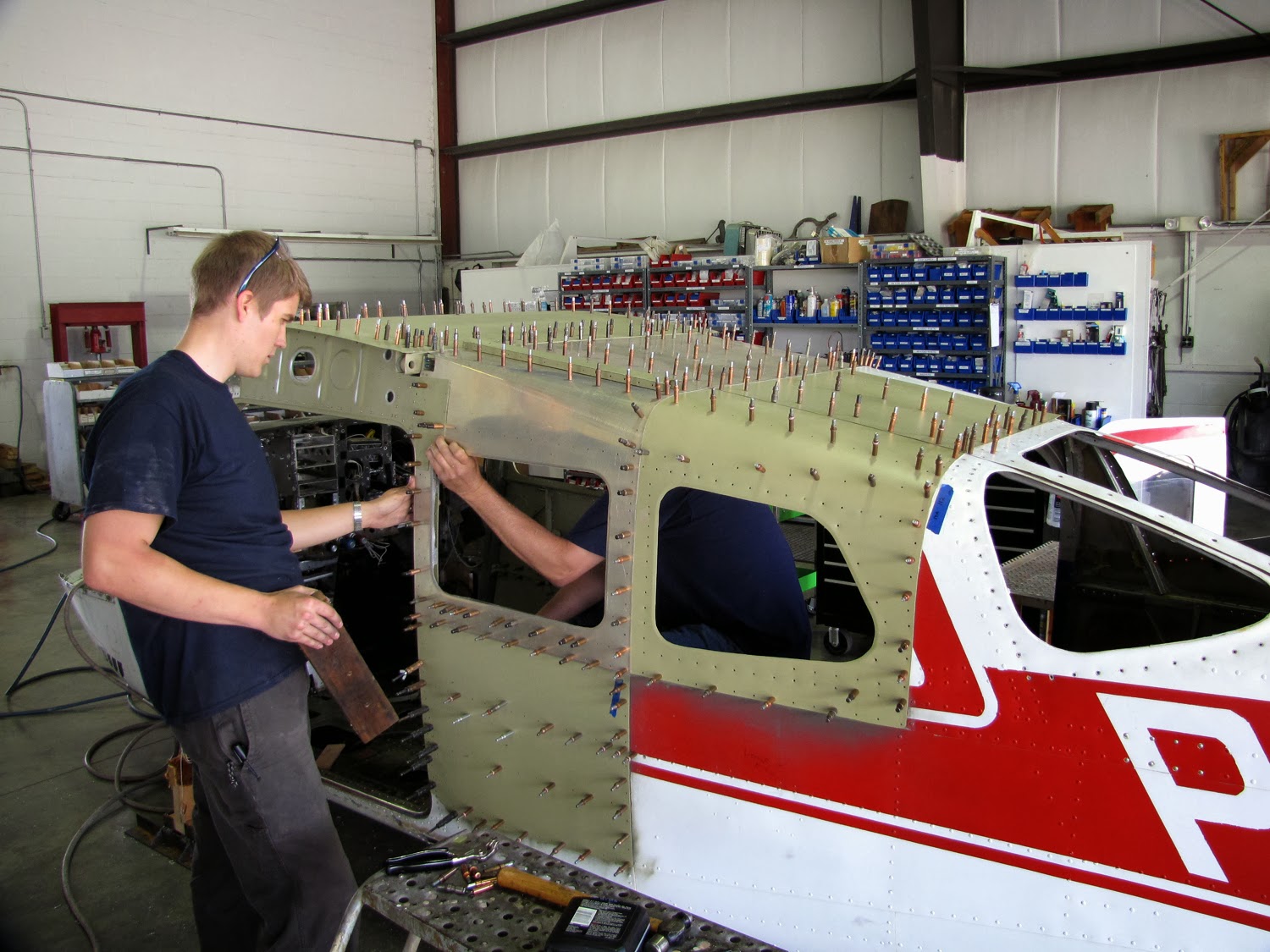
Work began in the upper forward cabin of this Cessna U206F.  Chuck cleans the wing support structure so it can be properly inspected.  Disassembly was accomplished by removing rivets that held the various pieces together. 
Airworthy parts were cleaned and painted before reassembly.  Parts that were damaged were replaced with new parts.

Work progressed from the upper forward cabin to the tail cone.

When the tail cone repair was complete the fuselage was rotated onto its left side to work on the belly and landing gear support structure.  The last two skins to be replaced have been removed.
 

Chuck and Jake use floor support structure to check rivet hole patterns because sometimes there are more holes in the old skin than need to be in the new one.  New aluminum sheet is below the original skin that is the pattern for the new skin.

The airplane being refurbished/restored was used most recently in Indonesia and may have been in Africa before that.  It will next be used in Suriname and based in a costal city so corrosion prevention is a priority.
 
This plane is a 1976 model and it's important to remember that it has been well maintained and safely operated by missionary aviators for nearly 37 years.  With the work MMS Aviation mechanics are doing, who knows, we may see it serve another 37 years in missionary aviation. 

Tuesday, September 3, 2013

A Look Back at April 2013

Before I summarize a very busy summer in the next blog, April at MMS Aviation needs mentioned.  Major aircraft maintenance events begin and finish throughout the year at MMS.  Typically this heavy maintenance involves repair following accidents and incidents, engine overhauls, or complete restorations.  Many times significant work on an airframe is combined with an engine overhaul.
 
To have three of these projects completed within a week of each other is rather rare and a bit exciting.


The top snapshot above is of a Cessna 206 that was completely restored after many years of use in four different countries by Mission Aviation Fellowship.  The Cessna Cardinal in the center picture is owned by two ministries in Wisconsin and received an annual inspection and some airframe repair along with an engine overhaul.  The Piper Lance in the lower photo is owned and operated by LAMP in Canada and had its engine overhauled.  The Lance also got new carpet installed in the cabin, several windows replaced, and repair and repainting of external fiberglass parts.

April was a fun month.

Tuesday, May 28, 2013

Prayers for The Hoblits, MMS Aviation, and MAG

Brad and Crystal Hoblit successfully completed their application/evaluation process last week and were accepted as MMS' newest apprentice family. The Hoblits intend to complete maintenance training with MMS before making the move to Burlington, NC where they'll pursue the additional flight training component offered through our partnership with Missionary Air Group (MAG).

Speaking of MAG, several members of MAG's operational staff were in the hangar last Monday for meetings, aviation maintenance strategy sessions, and to participate in the Hoblit's candidate evaluation: Sean Donnelly, President & CEO; Scott Grote, Director of Aviation Maintenance; Keith Dodson, Director of Operations; and Paul Jones, Guatemala Program Director. Paul just returned from a year of language school in Costa Rica and will make the move to Guatemala later this summer. Both Scott and Paul are graduates of MMS apprenticeship.

Scott, Paul, and Sean utilize the MMS Supervisor's Office.

Brad drills holes in the front spar of a horizontal stabilizer...

...and squeezes rivets on a bulkhead frame as part of his technical evaluation conducted by MMS Staff.

He also underwent a consultation flight with Paul Jones, 
MAG's Guatemala Program Director.

Paul and Brad debrief after the flight.

Brad, Crystal, and Lillia Hoblit

The Hoblits have returned home to the Dayton, Ohio area to raise the financial and prayer support necessary to begin service. Please pray for Brad, Crystal, and Lillia as they embark on this new adventure to join us in Coshocton, OH.

And please pray for MMS and MAG as we continue refining roles and responsibilities related to our growing operational relationship and training partnership.

Thursday, May 23, 2013

Structure, Wiring, Inspection, and an Engine Run

 Here are a few snapshots of our current projects:

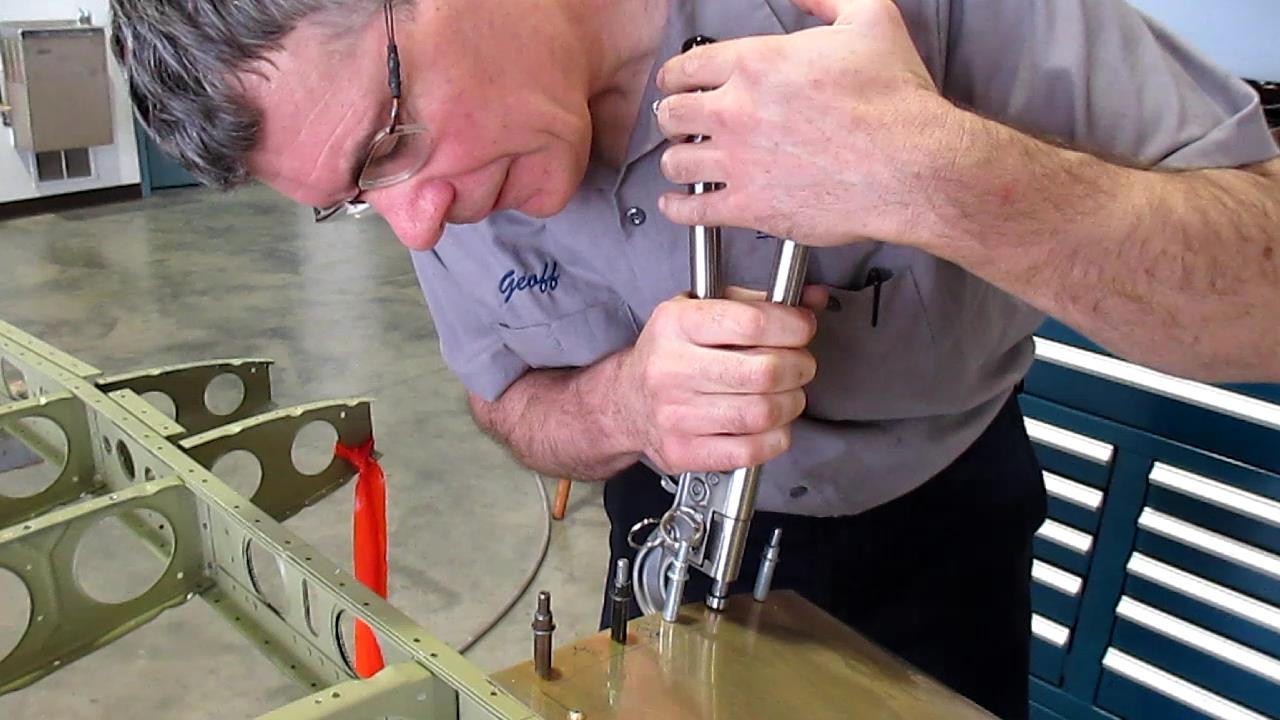
Geoff dimples a new leading edge skin as part of a horizontal stabilizer modification for Missionary Air Group's Cessna 206 down in Rus Rus, Honduras.

Chuck removes corrosion on the airframe of a Cessna 206 being restored for ministry in Suriname.

Andy and Mike discuss how to best route the wiring for the engine analyzer they're installing on Gospel Carrier International's Cessna 172.

Terry cleans the engine of a regional Piper Cherokee undergoing annual inspection.

Josh uses a digital tachometer during the test run of an engine we overhauled for New Life Ministry's Piper Aztec.

Tuesday, April 23, 2013

What happened to the engine?

While the Lycoming IO-360 overhaul was being completed, the airframe it arrived on was going through its own renewal.  An annual inspection was underway and unsafe conditions discovered were being corrected.
Sturdy jacks kept the plane stable during landing gear repair and adjustment.
Without its engine and propeller the Cessna Cardinal looked a bit like a glider.  After repair of the engine mount and landing gear the plane came off the jacks and was ready for engine installation.

Jake readies the engine for installation as Mike supervises.
With engine and prop in place Geoff and Jake make sure the lower cowl fits.


The post-inspection engine run revealed a faulty tachometer that had to be changed, but the engine performed beautifully and that's just the way we like it.
Mike "fights" the upper cowl made more difficult to install by new rubber air seals on the engine baffles.

The Cardinal was certified as airworthy April 16th and on April 20th the owner flew it back to Wisconsin where it will continue to support Christian ministry.
Ready to go back to work.

Saturday, March 2, 2013

Engine Overhaul - a Quick Overview

There are two reasons MMS Aviation overhauls reciprocating aircraft engines. One is to give the operators of airplanes used in Christian ministry a top quality engine overhaul at as reasonable a cost as possible (it's still expensive). The other reason is to give MMS' apprentice mechanics the experience of overhauling an engine. It isn't likely that any of them will perform an engine overhaul in the field, but having the experience will help them maintain the engines under their care.

Heartland Embrace, a ministry in Central Wisconsin, sent their Cessna Cardinal to MMS for an engine overhaul and some airframe work. The first step was to remove the engine from the plane after which the engine was disassembled in the engine shop.

Scott starts the process by removing the propeller.

Lots of photos are taken for reference at this stage.
A digital camera is a very important tool during engine removal and disassembly, as pictures are a great help in remembering how hoses, fittings, and wiring go back in the right place. Engine accessories and many parts that will be re-used are sent to specialty shops where non-destructive inspection, reconditioning, and certification take place. MMS does not do a volume of engine work to justify having these specialty services in-house. When all the parts to be re-used are back and new parts have arrived, measuring and reassembly begins. All dimensions are kept in the engine's work records.

Geoff measures a hole in the crankcase where a tappet body will ride.
Checking the camshaft timing on the partially assembled engine.
Once the engine is back together with its reconditioned and new parts, it must be tested. Part of MMS' engine overhaul facility is a test cell, a room designed to minimize noise and provide a place for safe engine operation.

In the test cell, instrumentation is connected to monitor engine condition throughout the test.
Nearly ready to run, the test propeller is on. An air scoop will be installed to direct the cooling air over the engine.

The "hood" is up so adjustments can be made.
The Heartland Embrace engine was operated briefly in the test cell yesterday afternoon. The full test will be performed Monday. Stay tuned.